
Why homeowners really say: “I need to think about it.”
The objection you hear isn’t always the objection stopping the sale.
Learn to distinguish the stated objection from the underlying uncertainty.
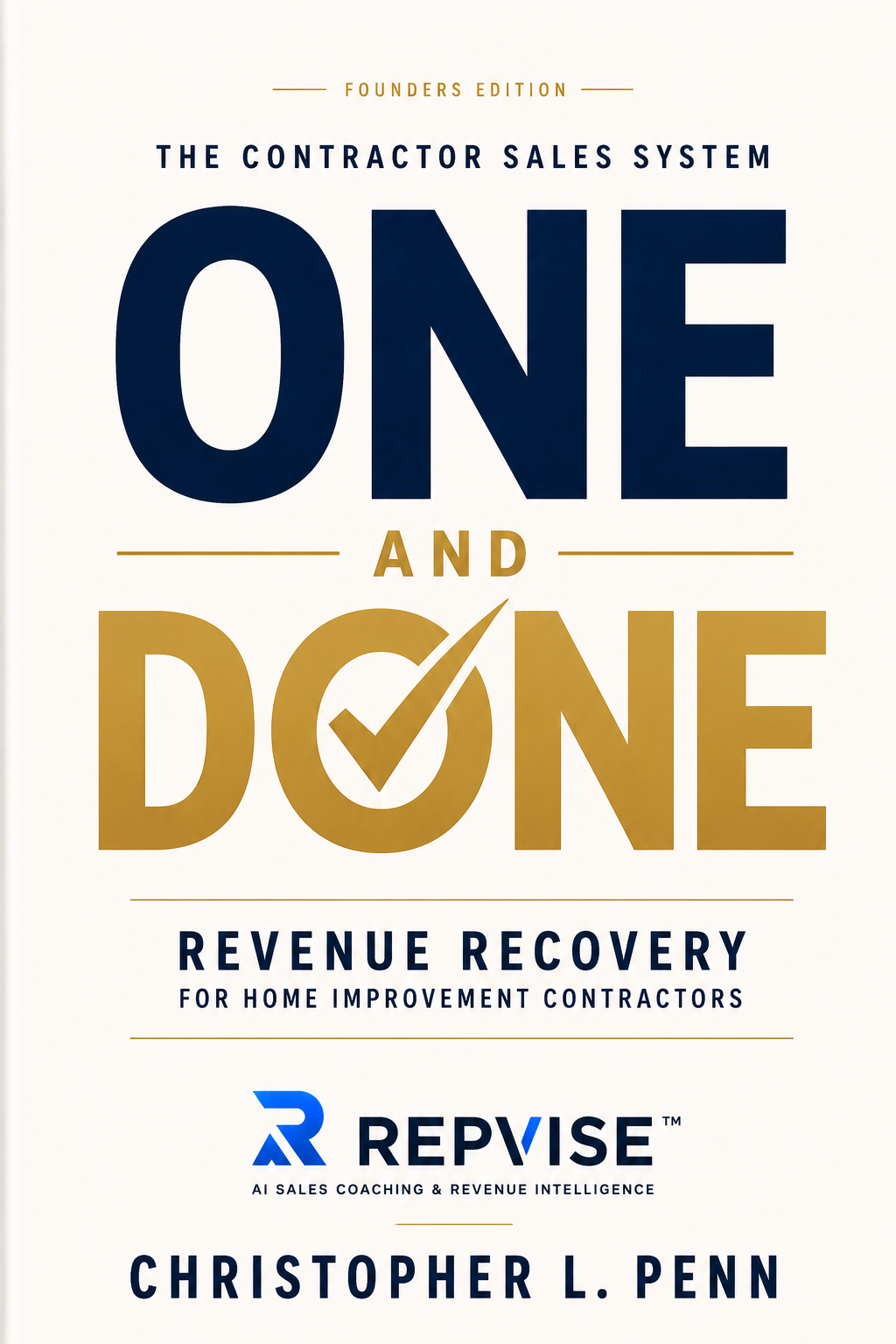
One and Done™
The most expensive sale in home improvement may be the one you already paid to create — and never closed.
After 25+ years and more than $20 million in home-improvement sales, Christopher L. Penn breaks down what really happens inside the one-call-close sales process, why good opportunities die, and what contractors can do about it.
By Christopher L. Penn · The sales philosophy behind revenue recovery.
You may have a conversation problem.
Contractors spend thousands — sometimes hundreds of thousands — of dollars generating leads.
Then everything comes down to one appointment.
A salesperson walks into the home.
A conversation happens.
And a few hours later, your CRM says:
But that doesn’t tell you what actually happened.
That is the problem One and Done™ was written to expose.
One lead.
One appointment.
One shot.
For decades, home-improvement sales organizations have operated around the one-call-close.
There is nothing inherently wrong with that model.
The problem is what happens when the customer doesn’t buy.
Too often:
One and Done™ challenges that thinking.
Because the appointment may be over.
The opportunity may not be.
Exclusive One and Done™ preview
A short excerpt from One and Done™ that reveals why many home-improvement companies keep buying more leads while revenue continues leaking inside the sales process.

Christopher L. Penn didn’t build this philosophy from a spreadsheet.
He lived it.
For more than 25 years, Christopher has worked in high-ticket home-improvement sales, sitting across kitchen tables from homeowners making some of the largest purchasing decisions of their lives.
More than $20 million in career sales. Thousands of homeowner conversations.
And deals that should have been dead — but weren’t.
One and Done™ is built from those experiences.
Not sales theory from someone who has never carried a quota. Real lessons from the kitchen table.
“Sales organizations spend an enormous amount of time teaching people what to say — and surprisingly little time understanding what actually happened.”
The objection you hear isn’t always the objection stopping the sale.
Learn to distinguish the stated objection from the underlying uncertainty.
Price matters.
But “too expensive” can hide problems with trust, value, urgency, product understanding, financing, presentation, or confidence.
A salesperson doesn’t need to make one catastrophic mistake to lose a deal.
Small breakdowns compound.
“Lost — Price.” “Lost — Competitor.” “Lost — Think About It.”
Those aren’t sales analyses. They’re labels.
Your customer already told you what matters.
The question is whether your organization captured it.
The first conversation can become intelligence for the second conversation.
Selected book insights
Not guess.
Not ask the salesperson two days later.
Not depend on a CRM dropdown.
Actually understand what happened inside the conversation.
That changes sales management.
It is about understanding.
Understanding the homeowner.
Understanding the salesperson.
Understanding the conversation.
Understanding why revenue was won.
And understanding why revenue walked out the door.
Because when you understand why sales are lost, you finally have the ability to do something about them.
What the book teaches
Show up ready. Research the lead, the address, the product, and the likely objections before knocking.
The first 60 seconds set the tone for the entire appointment. Arrive as a professional, not a pitchman.
Earn trust through genuine curiosity and respect for the homeowner's time, home, and decision.
Frame the appointment so the homeowner knows what to expect, what you need, and how a decision gets made.
Diagnose the problem, motivation, priorities, timeline, and decision process before recommending anything.
Move through the home with the homeowner so the diagnosis is shared, not delivered.
Anchor the solution in the homeowner's own words from discovery, not a feature tour of the product.
Establish the cost of doing nothing before presenting the price. Value earns the number.
A direct, respectful close is the professional's job — not a pressure tactic.
Isolate, acknowledge, resolve. When a second visit is required, run it as a system, not a hope.
You probably know:
But do you know the value of the opportunities you’re already generating but failing to convert?
Enter a few basic numbers about your sales operation and see what even a small improvement in conversion could mean to your business.
No generic sales score.
No motivational fluff.
Just the economics of the opportunities you’re already paying for.
Illustrative example
This creates approximately
This does not mean $1,050,000 was realistically recoverable.
Not every opportunity will close.
The point is that even a small improvement in conversion or recovery can materially impact revenue without requiring another lead source.
Illustrative estimates only. Actual sales performance and recovery potential vary. Not every unsold opportunity is recoverable, and potential contract value should not be interpreted as guaranteed or lost revenue.
Before you spend more money creating opportunities, understand what happened to the ones you already had.
After years of studying sales conversations, Christopher began asking:
What would happen if technology could analyze the conversation itself?
Not simply transcribe it.
That question became
RepVise™
AI Revenue Intelligence Built for Home Improvement.
RepVise helps home-improvement companies turn sales conversations into usable intelligence.
Analyze. Score. Coach. Understand. Recover.
One and Done™ teaches you to look beyond the final disposition.
RepVise™ helps companies examine what actually happened before the disposition was entered.
Together, they ask three simple questions:
One and Done™ was written for the people responsible for producing revenue in high-ticket home improvement.
Anyone tired of spending more money on leads without understanding what happens after the appointment is set.
There are thousands of books about selling.
One and Done™ is about something more fundamental.
And the difference between:
“We didn’t sell it.”
One is a result.
“We understand why we didn’t sell it.”
The other is intelligence.
For more than 25 years, I’ve sat at kitchen tables selling home-improvement projects.
I’ve experienced the adrenaline of the close and the frustration of driving away knowing a deal should have happened — but didn’t.
I’ve heard almost every objection imaginable.
Some were legitimate.
Some were smokescreens.
And some were signals that I hadn’t done my job well enough.
Eventually I realized something:
The sales industry spends an enormous amount of time teaching people what to say — and surprisingly little time understanding what actually happened in the conversation.
That’s why I wrote One and Done™.
And it’s ultimately why I built RepVise™.
Because every conversation contains information. The companies that learn how to use that information will have an enormous advantage.
— Christopher L. Penn
Founder, RepVise™
Don’t let the intelligence disappear with it.
Read One and Done™.
Understand the philosophy.
Then discover what your own sales conversations may be telling you.
See how RepVise™ can help your organization analyze sales conversations, identify coaching opportunities, understand lost revenue, and uncover opportunities that may deserve another look.
Related reading
One and Done™
A sales philosophy for home-improvement companies that spend too much money generating opportunities to stop learning when the customer says no.
By Christopher L. Penn
Founder of RepVise™
RepVise™
AI Revenue Intelligence for Home Improvement